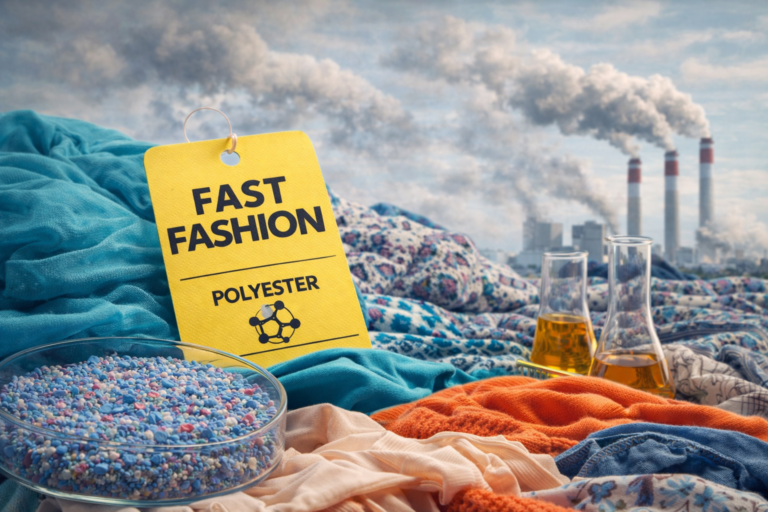
Fast Fashions Plastic Problem
Written by Zoe Roth
If you walk into almost any fast fashion store, nearly every item you touch is made of plastic. Polyester sweaters, nylon pants, acrylic scarves, you name it. Synthetic fibers dominate the modern clothing industry, and their popularity is no accident. These materials are durable, cheap, and versatile, making them the perfect fit for an industry built on rapid turnover and low production costs.
Synthetic fibers are man-made materials derived from chemical compounds, primarily petroleum and coal. Unlike natural fibers such as cotton or wool, which originate from plants or animals, synthetic fibers begin with monomers: small molecules that chemically bond to form polymers. This process, known as polymerization, creates long chains of repeated units that can be stretched into threads. The specific polymer determines the fiber’s properties. Polyester, the most widely used synthetic fiber, is made from polyethylene terephthalate (PET). Its molecular structure gives it strength, wrinkle resistance, and quick-drying capabilities. Another common synthetic fiber, nylon, comes from polyamide polymers. Its elasticity and abrasion resistance make it popular in activewear and swimwear. Acrylic fibers, designed to mimic wool, are made from polyacrylonitrile (PAN), which gives them a soft and lightweight feel. Together, these chemically engineered fibers demonstrate how science has reshaped clothing manufacturing to meet the demands of modern life.
According to the Textile Exchange, polyester alone accounted for 54 percent of global fiber production in 2022. When combined with other synthetic fibers, that number rises to roughly 65 percent. Beyond clothing, synthetics appear in countless everyday products, including carpets, seat belts, curtains, and bedding. Manufacturers favor these materials because they can be produced cheaply and consistently. Unlike natural fibers, which depend on weather conditions, soil quality, and harvest cycles, synthetic fibers are created through industrial chemical reactions that can be replicated anywhere. For consumers, the appeal is obvious: synthetic clothing is easy to care for, resists stains, and holds its shape.
Despite these advantages, synthetic fibers carry significant hidden costs. Most are derived from nonrenewable fossil fuels, contributing to greenhouse gas emissions during production. Because they are essentially forms of plastic, they are not biodegradable and can take hundreds of years to decompose in landfills. Additionally, every time a polyester or nylon garment is washed, it sheds tiny plastic particles known as microfibers. These microplastics pass through wastewater systems and enter oceans, where they accumulate in marine ecosystems and food chains.
Fast fashion’s business model intensifies these environmental problems. The low cost and mass availability of synthetic fibers encourage overproduction and overconsumption. When clothing is designed to be cheap and disposable, it is often worn only a few times before being thrown away. This creates a cycle of waste that depends on continuous fossil fuel extraction. Addressing the environmental impact of synthetic fibers requires change at both the industrial and consumer levels. Companies can invest in alternative materials such as recycled polyester, biodegradable polymers, and innovative textiles to reduce reliance on fossil fuels. Brands can also slow production cycles and promote clothing recycling programs to extend garment lifespans. Consumers, meanwhile, can make a meaningful difference by buying fewer, higher-quality items and choosing second-hand or thrifted clothing. Ultimately, understanding what our clothes are made of is the first step toward reshaping a fashion system that values sustainability alongside style.